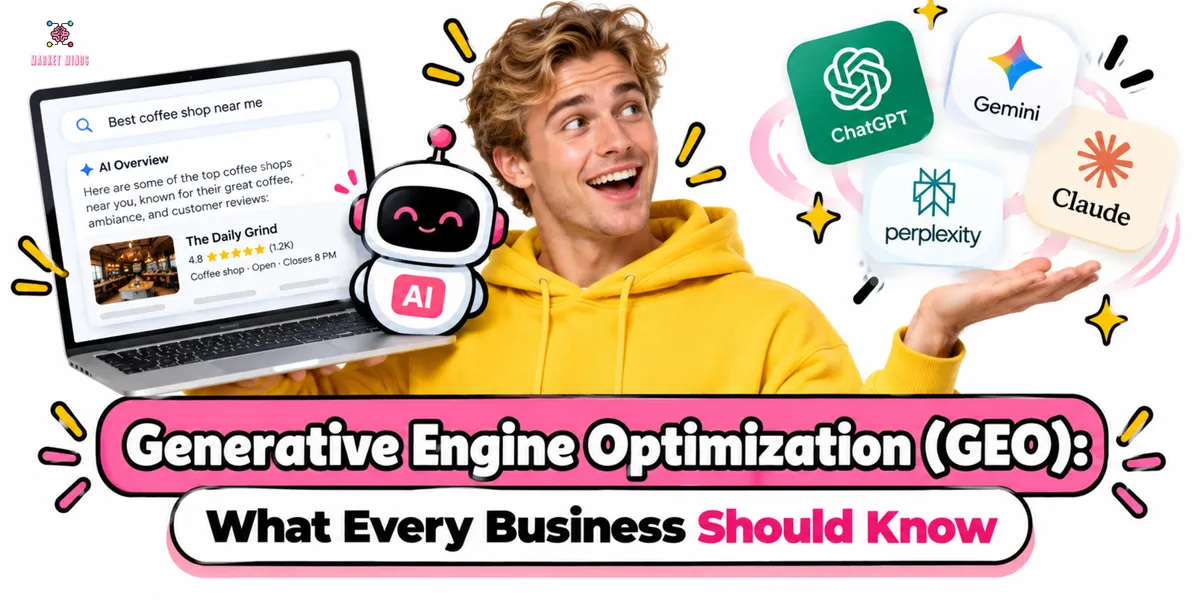
Generative Engine Optimization (GEO): What Every Business Should Know Post
Search is changing. People are no longer relying only on traditional search results to find answers, compare businesses, research products, or decide which companies deserve their attention. AI-powered search experiences can now summarize information, answer questions conversationally, compare options, and direct users toward sources they consider relevant.
This shift has introduced a growing area of digital marketing known as Generative Engine Optimization, or GEO. For businesses, GEO is not simply about replacing traditional SEO with a new technique. It is about making online information easier for AI-powered search systems to understand, evaluate, and potentially reference when generating answers.
That means businesses need to think beyond rankings. They also need to consider authority, relevance, clarity, structured information, content quality, and how consistently their expertise is represented across their digital presence.
What Is Generative Engine Optimization (GEO)?
Generative Engine Optimization (GEO) is the practice of improving your content and online presence so AI search tools like ChatGPT, Perplexity, and Google's AI features can understand, trust, and cite your business when generating answers. It builds on traditional SEO rather than replacing it.
Traditional SEO generally focuses on helping web pages appear prominently in conventional search engine results. GEO considers how information may be interpreted and used by generative search systems and large language models.
The two approaches overlap significantly. Both depend on useful content, relevance, authority, technical accessibility, and a clear understanding of what users are searching for. However, generative search can place greater emphasis on whether content provides clear answers and whether information can be confidently interpreted within a broader context. GEO should therefore be viewed as an extension of a strong search strategy rather than a replacement for SEO.
Why Is GEO Becoming Important for Businesses?
Search behavior is becoming increasingly conversational. Instead of typing a short phrase such as "best marketing agency," a user might ask an AI search tool:
"How should a growing business choose a digital marketing agency?"
The second query contains more context and requires a more comprehensive answer. Businesses that publish useful, well-organized information around the questions their customers ask can provide valuable material for these types of searches.
This does not mean a business can guarantee that an AI system will mention its website. Generative systems use different sources and processes, and their responses can change. The practical goal is to build a digital presence that demonstrates genuine expertise and provides information that search systems and users can understand.
GEO and Traditional SEO Work Together
One of the biggest misconceptions about GEO is that businesses need to abandon traditional SEO. They do not. Search engine optimization remains an important foundation because search visibility, crawlability, relevant content, technical performance, and website authority continue to matter. A business that ignores SEO fundamentals is unlikely to build a strong foundation for generative search visibility either.
For this reason, businesses should approach SEO as part of a broader search strategy, and working with a team that offers SEO services can help support both conventional search and emerging AI-driven discovery. GEO builds on that foundation by focusing more heavily on how information is presented, understood, and connected to specific user questions.
1. Create Content Around Real Customer Questions
The first step in a GEO strategy is understanding what your audience actually wants to know. Keyword research remains useful, but businesses should also identify complete questions and problems that customers encounter throughout the buying journey.
For example, instead of creating content only around "digital marketing agency," a business could address questions such as:
How does a digital marketing strategy support business growth?
What should businesses consider before investing in paid advertising?
How can companies improve their organic search visibility?
What makes a website effective for generating leads?
How should businesses evaluate marketing performance?
Answering these questions gives content greater contextual value. It also creates opportunities for a business to demonstrate practical knowledge rather than simply repeating a keyword.
2. Deliver Direct, Extractable Answers
Generative search systems are designed to provide users with answers, so content should make important information easy to identify. This does not mean every article should be reduced to short answers. Detailed explanations remain valuable, but important questions should be addressed clearly before expanding into supporting information.
Useful formatting can include descriptive headings, concise introductory explanations, lists, tables where appropriate, and clearly organized sections. A reader should be able to understand the main point without having to navigate through unnecessary promotional language.
Here is what the difference looks like for the question "What is Generative Engine Optimization?"
Bad (wordy, answer buried):
"Search has been evolving for many years, and with new technology emerging all the time, a lot of businesses are wondering how to keep up. There are many factors to consider, and different experts have different opinions, but one concept that has come up recently is something people are calling GEO, which relates to how content may show up in certain types of search results."
Good (direct, AI-friendly):
"Generative Engine Optimization (GEO) is the practice of improving your content so AI search tools can understand it, trust it, and cite it when answering questions. It builds on SEO fundamentals such as useful content, authority, and technical accessibility, with extra focus on clear, well-structured answers."
The good version leads with a clear definition, then adds context. The bad version makes both readers and AI systems work to find the point. Clarity benefits both people and search systems.
3. Demonstrate Genuine Expertise
GEO makes authority particularly important because AI-generated answers depend on information that systems can interpret as relevant and credible. Businesses should demonstrate expertise through the depth and accuracy of their content.
Instead of publishing generic articles that provide surface-level explanations, businesses can share practical frameworks, industry observations, examples, common mistakes, decision-making guidance, and explanations based on real experience. The objective is not to make every piece of content complicated. It is to make it genuinely useful. Content should answer the questions a knowledgeable professional would expect to receive from a prospective customer.
4. Build Comprehensive Topical Depth
A single article rarely establishes strong topical authority on its own. Businesses should develop connected content around important areas of expertise.
For example, a company focused on digital marketing might create related resources covering technical SEO, paid advertising, website design and performance, social media management, conversion optimization, and marketing strategy. These topics can then connect naturally through internal links.
Taking a broader digital marketing strategy approach can help businesses organize these different areas into a more cohesive online presence. This gives visitors additional resources while helping create stronger relationships between related topics across the website.
5. Keep Information Accurate and Current
Accuracy matters for both traditional and generative search. Outdated statistics, old service information, broken links, unsupported claims, and inaccurate business details can reduce the usefulness of a page. Businesses should periodically review important content to ensure that information remains relevant, especially for subjects affected by technology changes.
GEO itself is developing quickly, and strategies that appear effective today may evolve as search platforms and AI systems change. A sustainable approach is to focus on fundamentals such as accuracy, expertise, relevance, usefulness, and a strong user experience rather than chasing every new optimization trend.
6. Make Your Business Information Consistent
AI systems rely on information from different sources, so businesses should aim for consistency across their digital presence. Important details such as the company name, services, business description, areas of expertise, and other relevant information should be accurate wherever the business is represented online.
Inconsistent information can create confusion for customers and make the overall digital presence harder to interpret. A clear website should serve as the central source of information, supported by consistent information across relevant external platforms.
7. Use Internal Linking Strategically
Internal links are useful for more than navigation. They help users discover related information and create connections between pages on a website. For GEO, this can be particularly useful when several pages address different parts of the same broader subject.
For example, an educational article about SEO can link to a relevant service page while explaining how professional SEO support fits into the wider strategy. The link should make sense within the surrounding discussion. Internal linking should not be added simply to increase the number of links on a page, because each link should help the reader continue their research.
8. Optimize for People First
It can be tempting to treat GEO as another technical optimization exercise, but that approach can create content that is overly repetitive, unnatural, or written primarily for algorithms. The better approach is to start with the audience.
Ask what information a customer needs before making a decision. Identify the questions they are likely to ask. Explain complicated concepts clearly, and provide evidence where appropriate. Then organize that information in a way that is easy for both people and search systems to understand. When content is genuinely useful to people, it has a stronger foundation for search visibility across different formats.
9. Consider the Entire Customer Journey
Not every AI-generated search represents the same stage of the buying process. Some users are simply researching a topic, others are comparing solutions, and some may already be looking for a specific service provider. Businesses should create content that supports each stage:
Research stage: Informational content that answers early questions.
Comparison stage: Detailed comparison or decision-making resources for users evaluating options.
Decision stage: Service pages that give ready-to-act visitors the information they need.
This creates a connected content ecosystem rather than relying on one page to serve every search intent.
10. Measure Modern Visibility Holistically
GEO measurement is still developing, so businesses should be cautious about claims that promise guaranteed placement in AI-generated answers. Instead, start with a few practical tracking methods:
Run a monthly AI visibility test. Choose five core questions your customers ask, then test them each month in ChatGPT, Perplexity, and Google. Record whether your business is mentioned or cited, which sources appear instead, and how competitors are described.
Track AI referral traffic. In your analytics platform, such as Google Analytics, review referral sources for visits coming from AI tools like chatgpt.com and perplexity.ai, and see which pages those visitors land on and whether they convert.
Monitor search and brand signals. Use Google Search Console to watch impressions and clicks for question-style queries, and keep an eye on branded search trends and conversions alongside them.
The objective is to identify opportunities rather than assume that one metric can completely measure GEO success.
Common GEO Mistakes to Avoid
Businesses entering generative search should avoid several common mistakes:
Publishing large amounts of low-value content: More content does not automatically create more authority.
Overusing keywords: Repeating a phrase excessively can make content difficult to read and does not create genuine expertise.
Making unsupported claims: Content should be accurate and transparent about what is known.
Ignoring traditional SEO: GEO does not eliminate the need for strong technical and on-page SEO.
Writing only for AI systems: Content still needs to satisfy the people who read it.
Chasing every new AI trend: Sustainable search strategies should focus on useful information and strong fundamentals.
What Should Businesses Do Next?
Businesses do not need to completely rebuild their websites to start preparing for generative search. A practical starting point is to review existing content and identify areas where important customer questions are not being answered.
Next, strengthen high-value pages with clearer explanations, useful supporting information, relevant internal links, and evidence of expertise. Businesses can then develop additional content around related questions and topics while maintaining a consistent website structure. This process can strengthen traditional SEO while also making the business's information more useful for AI-driven search experiences.
Final Thoughts
Generative Engine Optimization represents an important development in how people discover information online, but the fundamentals remain familiar. Businesses need accurate information, useful content, clear expertise, strong websites, and a consistent digital presence.
The most effective GEO strategy is not about trying to manipulate an AI system into mentioning a company. It is about becoming a credible source of information that deserves to be discovered. As search continues to evolve, businesses that invest in helpful content and a well-structured digital presence will be better positioned to adapt.
If your business wants to strengthen its visibility across traditional and emerging search experiences, the Market Minds Creative team can show you where to start with an SEO and digital marketing strategy built around your business goals.
Frequently Asked Questions
1. Is GEO replacing traditional SEO?
No. Generative Engine Optimization builds on established SEO principles and should work alongside traditional search optimization. Fundamentals like crawlability, site speed, and quality content still determine whether your pages can be found and trusted at all. For example, a page that search engines cannot crawl is unlikely to be cited by an AI tool either.
2. How can businesses start with GEO?
Start by identifying the questions your customers ask most often, then create clear, genuinely useful answers to them. A simple first step is to review your key service pages and add a short, direct answer at the top of each one, followed by supporting detail. From there, improve weaker content and strengthen your site's overall authority with connected articles and internal links.
3. Does GEO guarantee AI search visibility?
No. AI-generated results can vary by platform, by prompt, and even from one day to the next, so no business can guarantee that its content will be selected or cited. For example, the same question asked in ChatGPT and Perplexity may surface different sources. Be cautious of any provider that promises guaranteed placement in AI answers.
4. Is keyword research still important for GEO?
Yes. Keyword research can help identify topics and search behavior, but GEO also requires understanding complete questions, context, and user intent. For example, alongside targeting "digital marketing agency," you might also address "How should a growing business choose a digital marketing agency?" Google Search Console can help you spot the question-style queries your audience is already using.
5. Can Market Minds Creative help with GEO?
Yes. Market Minds Creative provides SEO and digital marketing capabilities that can help businesses develop a stronger foundation for evolving search behavior. That can include reviewing existing content for unanswered customer questions, strengthening internal links between related pages, and setting up a simple process to track AI visibility. A free GEO audit is a good place to start.